
Updated through Outlander: Blood of My Blood Season 2 Episode 8, “The Dance.” The original Episode 1.06 scene analysis below is reconsidered in light of later revelations.
Episode 6 keeps circling the same ugly question: is Lord Lovat really the father of Julia’s baby, or is Blood of My Blood still playing some kind of sleight of hand with the truth? Current answer: NO. William Henry Beauchamp is the biological son of Julia and Henry Beauchamp, not Lord Lovat. The later story makes clear that Julia protected William’s true identity while Lovat claimed the boy as Simon Fraser of Lovat. Episode 1.06 deliberately uses the accusation to trap Julia, and the reveal changes how we read her choices. The bigger issue is not “who done it.” The bigger issue is what the accusation reveals about power, shame, and how women get cornered in this world.
Season 2 Update: Why Does Lord Lovat Still Claim William?
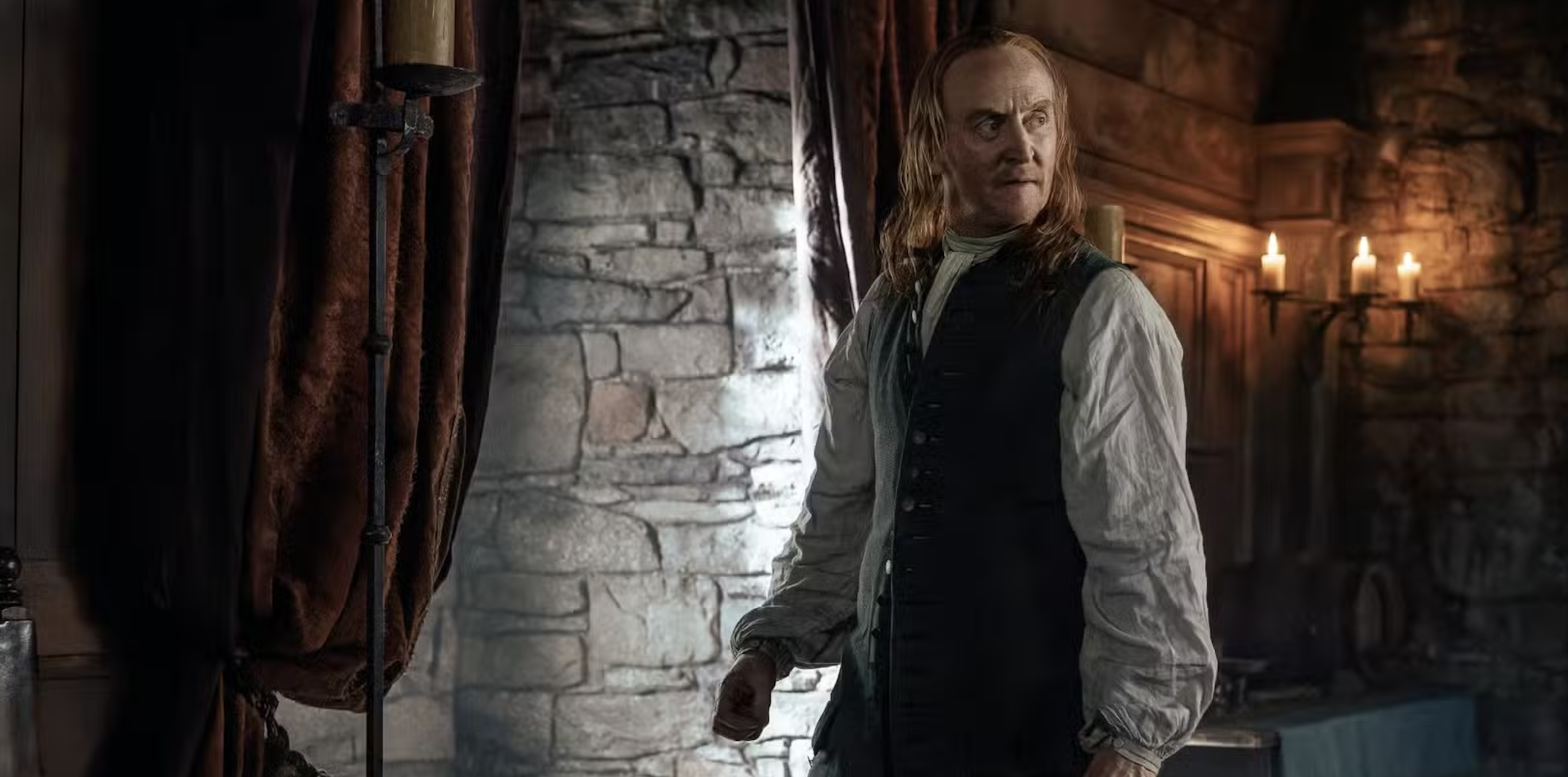
Even after his biological paternity is known to the audience, Lovat treats William as his political and dynastic possession. In “The Dance,” Lovat’s newly restored status attracts Margaret Grant, and Henry and Julia become afraid that Lovat could kill Julia, marry Margaret and keep William. That is their fear, not a murder order the episode has proved. Maisri’s prophecy explains the stakes: Lovat wants a son who will secure the future he imagines for himself. See our complete William Henry Beauchamp explainer for the confirmed identity and the time-travel revelation.
Why Episode 1.06 Made Lovat Seem to Be the Father
Viewed on its own, the “Birthright” scene has Julia repeatedly insist that Lord Lovat is the father. Later revelations let us understand that as a protective claim made under coercion, not proof of paternity. She is willing to swear to it. What she refuses is the specific demand that she swear on her baby’s life, because for her that crosses into something morally grotesque. That distinction matters. The revelation that Henry is William’s father changes the first part of that reading: Julia is protecting the truth of the child’s parentage, but she is also refusing a ritual that would place an innocent baby’s life at risk.
That is a very different dramatic beat than “woman caught in a lie and dodging the proof.” It plays much more like “woman trapped in a room full of people who think cruelty is discernment.”
Why the episode makes it feel murkier than it is
Because “Birthright” is less interested in paternity as a puzzle than in paternity as a weapon. The episode turns fatherhood into leverage. The room wants a confession, but not because it loves truth. It wants submission. Lord Lovat wants certainty, but not because he suddenly cares about honesty. He wants control. And the community around Julia is happy to turn labor — already the most vulnerable physical state imaginable — into a tribunal.
That atmosphere makes everything feel more unstable. The audience starts second-guessing not because the evidence is especially slippery, but because the entire room is built to make Julia look suspect whether she is truthful or not.
Why Julia refusing to swear on the baby actually helps her case
This is the part I think the episode handles better than some viewers are giving it credit for. Julia’s refusal is not framed as panic. It is framed as principle. She will swear on her own life. She will swear on whatever else they ask. But she will not drag the baby into it. In story terms, that is a character beat before it is a plot beat. It tells us how she thinks. It tells us where her line is. It tells us that even while she is terrified and in labor, she is still trying to protect the child at the center of the accusation.
If the episode wanted us to read this as obvious deception, it would probably stage the moment differently. Instead, it stages the scene so that the people around her look more spiritually grotesque than she does.
So why do people still think there may be another father?
Because the episode keeps the social pressure high and because Blood of My Blood knows exactly what kind of show it is. This is a prequel in an Outlander-adjacent universe. Fans are trained to assume names matter, bloodlines matter, withheld information matters, and any delayed reveal is probably bait for a later turn. Add in the fact that the baby still goes unnamed by the end of the episode and the audience naturally starts looking for hidden doors.
That does not automatically mean there is a hidden door here. Sometimes a show withholds a name because it wants to stretch anticipation, not because it is secretly running a second-paternity twist. In hindsight, the withheld identity was significant after all: the child was William Henry Beauchamp, and Lovat’s publicly claimed fatherhood was not biological truth.
The real point is not the mystery. It’s coercion.
That is the piece I think matters most. The paternity question only has power because of the world it exists inside. A powerful man can use uncertainty as a cudgel. Other people can use religion and superstition as emotional blackmail. A laboring woman can be forced to defend herself in the middle of bodily crisis. Once you view the episode through that lens, the father question stops being clever intrigue and starts becoming social violence.
That is also why Davina matters so much here. Her response to Julia is inconsistent right up until it suddenly isn’t. Once the episode connects Julia’s treatment to Davina’s own history, the whole sequence stops being about “is Julia lying?” and becomes “how many generations of women are going to be brutalized by the same system before someone finally says enough?”
What about Brian?
Brian is emotionally important to this story, but Episode 6 does not actually build a persuasive paternity case around him. What it builds is emotional contrast. Brian’s presence sharpens the cruelty of the room. It highlights how exposed Julia is. It gives the audience another man measuring what kind of world this is and what kind of mother-son wound Davina has been carrying. That is valuable. But it is not the same thing as textual evidence that he fathered the baby.
What the show is probably saving for later
The baby’s identity matters. The name matters. The future line matters. That part I buy completely. The episode is obviously stretching that reveal because it wants the audience leaning forward into whatever comes next. But that is not the same question as who the father is. Those are related questions, not identical ones.
With the later episodes in view, the answer is clear: Henry Beauchamp is William’s father. The delayed name invited the audience to recognize how far Lovat’s control could extend over Julia and her child.
FAQ
Is Lord Lovat really the father of Julia’s baby?
No. William Henry Beauchamp is Julia and Henry’s biological son. Lovat claims him publicly as Simon Fraser of Lovat, but that is a claim to power, not proof of paternity.
Why doesn’t Julia swear on the baby?
Because she sees that as morally wrong and spiritually dangerous. The refusal reads more like protection than deception.
Does the unnamed baby mean there’s a twist coming?
Yes. The later story identifies the child as William Henry Beauchamp and reveals his importance to Julia’s time-travel mystery. His true father is Henry, not Lovat.
Could Brian still somehow be involved?
Emotionally, yes. Textually, Episode 6 does not build a strong case that he is the father.
This Week’s Blood of My Blood Coverage
Blood of My Blood Season 1 Coverage
What do you think? Is the episode actually giving us a paternity mystery here, or is it using that question to dramatize power and shame more than surprise?
Send us a voicemail for the next episode at SpeakPipe.com/MaryAndBlake.
Slàinte Mhath. 🏴