Full spoilers for Christopher Nolan’s The Odyssey follow.
Mary & Blake Rating: A+
Christopher Nolan’s The Odyssey is a masterpiece.
That word gets thrown around too easily, especially in the immediate rush after seeing a movie we loved. Here, it feels appropriate. The Odyssey is a masterclass in direction, cinematography, lighting, sound design, music, editing, performance, production design, adaptation, and almost completely perfect screenwriting.
The movie carries one of the largest and most familiar stories in Western literature across nearly three hours, dozens of characters, multiple countries, decades of history, fractured memories, gods, monsters, war, and political collapse. Somehow, it remains immediate, coherent, emotionally intimate, and completely alive.
Nolan found the way through all that scale by building the film around one question:
Can a man who destroyed the world still return home?
A Complicated Man At The Center Of An Epic
Nolan has said that Emily Wilson’s translation of Homer helped inspire his approach to the movie. Her opening request—“Tell me about a complicated man”—contains the entire adaptation.
Odysseus is brilliant, courageous, manipulative, loving, prideful, frightened, merciful, and capable of terrible choices. His greatest strength is also his most dangerous weakness. His intelligence ends the Trojan War, yet the Trojan Horse converts a sacred offering into a weapon and unleashes the destruction of Troy.
Odysseus believes that his ability to anticipate events makes him responsible for everything that follows. He commands the men, so every death feels like his failure. He invents the Horse, so the destruction of Troy becomes his crime. He hears prophecies and assumes that a sufficiently clever plan can overcome them.
His physical journey is an attempt to reach Ithaca, Penelope, Telemachus, and the life he left behind. His deeper journey concerns whether he believes he deserves to return to any of them.
That gives the movie its central dramatic argument:
Cleverness can win a war. Wisdom is understanding what the victory cost.
Go Deeper Into The Odyssey
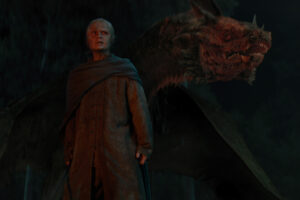
Two of the film’s most important images complicate Odysseus’s journey home: the uncertain presence of Athena and the burning monument to the victory that destroyed Troy.
The Trojan Horse Breaks More Than Troy
The movie opens with a magnificent progression delivered by Travis Scott’s bard: “A face. A fleet. A war. A man. A thought. A trick.”
That is the entire story compressed into a handful of words. Helen’s face becomes a story. The story launches a fleet. The fleet creates a war. The war reaches Odysseus. Odysseus produces a thought. That thought becomes the trick that burns a civilization to the ground.
The Trojan Horse solves an impossible military problem. It also destroys the trust that makes civilization possible.
The Greeks claim the Horse is an offering to Athena. The Trojans bring it inside because they recognize a shared god, a sacred gift, and a common understanding between human beings. Odysseus turns that understanding into a tactical vulnerability. His army enters Troy disguised as peace.
The screenplay connects that betrayal to Zeus’s law, the obligation to welcome strangers because any stranger might be a god in disguise. The law becomes the moral spine linking the entire movie together.
The Trojans welcome the Horse and are slaughtered. The Cyclops refuses hospitality and treats men as food. Circe welcomes soldiers and exposes the appetites they bring into her home. The suitors exploit Ithaca’s hospitality while abusing everyone beneath them. Eumaeus possesses very little, yet still treats a stranger with dignity.
Each encounter asks the same question:
How do you treat another person when you hold power over them?
Civilization survives through restraint, mercy, generosity, and responsibility. It begins to collapse when people become objects, resources, sacrifices, servants, bodies, or meals.
Is Zendaya Really Athena?
The first words of Nolan’s screenplay describe the setting as “a time of apparent magic.”
“Apparent” is doing enormous work.
The movie allows divine and human explanations to exist inside the same image. A storm may be Poseidon’s anger, or it may simply be weather. A prophecy may come from a god, or it may be the language people use to understand fear, consequence, and probability.
Zendaya’s Athena may genuinely be guiding Odysseus. She may also be guilt wearing the face of someone he could not save.
Throughout the movie, Athena appears at impossible moments, offers wisdom, disappears when other people arrive, and challenges Odysseus with truths he may already understand but cannot accept. We assume she is unquestionably the goddess because that is how Odysseus experiences her.
Then the film returns to the sack of Troy.
Odysseus watches a Greek soldier murder a grey-eyed Trojan woman with Zendaya’s face as another soldier cuts the head from Athena’s statue. Flesh and stone are destroyed together. From that moment forward, the woman, the goddess, Troy, strategy, guilt, and memory become inseparable inside Odysseus.
A goddess may have adopted the woman’s face to accuse him. His conscience may have transformed the woman into a divine visitor. His mind may be using mythology to process something too terrible to hold directly.
The film preserves every possibility.
That ambiguity makes Athena much more powerful than a simple answer ever could. We learn why she has this face without proving who is speaking through it. Nolan gives us emotional clarity while protecting the mystery.
The Nonlinear Structure Follows A Damaged Memory
Nolan’s nonlinear storytelling can sometimes be treated as an intellectual signature—a filmmaker rearranging chronology because he enjoys intricate structures. In The Odyssey, the construction grows directly from character.
Odysseus’s memories return when the present forces him to approach them.
A wooden plank on Calypso’s shore becomes the Horse. A stone head rocking against the floor becomes a broken memory. Athena’s face becomes the Trojan woman. A bowstring becomes identity. A heavy wooden beat becomes oral history, warfare, guilt, and song.
The editing does more than move us between periods. It allows separate images to collide and create a third meaning.
The flashbacks also emerge through relationships. Calypso wants Odysseus to remain, so remembering threatens the life she offers him. Penelope wants the truth about her husband, forcing the disguised Odysseus toward confession. Telemachus wants to understand the father he knows only through stories.
Every memory changes the relationship surrounding the person telling it.
The opening establishes this tension beautifully. A bard performs the heroic song of Odysseus in his own palace, and Penelope stops him. She does not want another performance of the legend. She wants the man who disappeared inside it.
The world knows what Odysseus did to Troy. Penelope wants to understand what Troy did to Odysseus.
Read The Full Knee-Jerk Reaction
Our complete premium review goes deeper into the Cyclops, Circe’s transformation of the soldiers, Zeus’s law, the final bow sequence, the sound design, 70mm IMAX photography, Penelope, Telemachus, Antinous, and why the screenplay is about 98 percent perfect.
Circe Turns The Movie’s Argument Into Body Horror
The transformation of Odysseus’s men into pigs is one of the wildest scenes Nolan has ever directed. It is tactile, frightening, disgusting, strange, and essential to the movie’s meaning.
Circe claims that she has revealed the soldiers rather than changed them.
The transformation refuses the polished visual language of a typical magical effect. Circe presses, rubs, kneads, and massages humanity out of the men. Their flesh becomes morally unstable beneath her hands.
When Odysseus arrives, the scene becomes a battle over what these men truly are. He sees soldiers who must be rescued. Circe sees rapists, thieves, killers, and consumers whose new bodies finally match their behavior.
Odysseus demands their humanity back. Circe describes that humanity as a disguise.
Samantha Morton plays the scene with fury, pain, and purpose. Circe lives alone in a world where armed men arrive hungry and expect hospitality to grant them access. The pigs are horrifying, but the scene leaves open the possibility that the men they become again are worse.
The sequence attacks the distinction between civilized soldiers and animals driven by appetite. Circe looks at the Greek army and sees pigs wearing armor.
The IMAX Photography Makes Scale Personal
Shooting the entire movie on 70mm IMAX film becomes far more than a technical achievement. Nolan and cinematographer Hoyte van Hoytema use the format to place intimate human suffering beside overwhelming historical scale.
Odysseus appears tiny against oceans, cliffs, armies, cities, and storms. He may be a king and legendary strategist, yet the sea can erase his plans in seconds. Troy may represent a great civilization, yet fire reduces its buildings to falling pieces of stone.
The same enormous frame studies Damon’s face as memory moves through him. Anne Hathaway’s eyes, Tom Holland’s uncertainty, Samantha Morton’s rage, Robert Pattinson’s contempt, and John Leguizamo’s loyalty receive the same cinematic weight as the Horse, the Cyclops, and the destruction of Troy.
That relationship between size and intimacy defines the film. Odysseus sees himself as the man whose idea changed history. The camera keeps reminding him how small one person remains inside history.
The lighting contributes to the same argument. Fire in Ithaca represents warmth, food, storytelling, family, and civilization. Fire in Troy becomes slaughter, rage, and collapse. The material is the same. Human behavior determines its meaning.
Sound Makes The Myth Physical
The sound design may be every bit as important as the cinematography.
The movie begins in silence before the surf rises and a wooden beat crashes through the darkness. That rhythm becomes the sound of the bard, the Horse, military action, memory, violence, and history being transformed into song.
During the sack of Troy, rhythm, screams, weapons, fire, collapsing stone, and Ludwig Göransson’s score press against one another until the city feels as though it is being physically torn apart.
The sea is equally alive. Wood groans. Water smashes against the hulls. Wind changes direction. Men row, breathe, shout, vomit, panic, and listen. The ships feel like fragile collections of timber, rope, labor, and faith surrounded by something much larger than human ambition.
The eventual pluck of Odysseus’s bow may be the most satisfying sound in the movie. The bow has been established as a weapon, an object of memory, a test of identity, and an extension of the man himself.
When the disguised Odysseus strings it and the sound moves through the hall, the revelation lands before anyone speaks his name. A beggar becomes a king. A feast becomes a battlefield. The heroic story everyone has been singing suddenly walks back into the room.
The Final Act Turns Setup Into Judgment
The return to Ithaca is enormously satisfying because almost every important detail has been planted earlier.
Odysseus’s scar connects him to the hunt and allows the nurse to recognize him. Argus embodies loyalty extended across twenty years. The lot connects Antinous to Sinon and the war he escaped. The begging bowl turns Zeus’s law into a test of every suitor. The bow carries Odysseus’s identity, skill, history, and ritual.
The final sequence works because each physical action also carries character meaning.
Odysseus studies the room, tests loyalties, positions weapons, involves Telemachus and Eumaeus, and turns the suitors’ arrogance against them. This is the same strategic mind that created the Trojan Horse, now operating inside a different moral context.
At Troy, Odysseus used hospitality to smuggle violence into another people’s home. In Ithaca, he enters his own home as a powerless stranger and lets its occupants reveal who they have become.
The suitors condemn themselves before he draws the bow.
Homecoming Is A Moral Event
The meaning of “home” changes throughout the movie.
At first, home is a location: Ithaca, Penelope, Telemachus, the palace, the dog, the bow, and the land Odysseus left behind. After Troy, home becomes a judgment. Returning means allowing the people he loves to see what the war made of him.
Calypso offers escape through forgetting. She can give him food, beauty, companionship, and relief from his memories. That relief also separates him from the identity and desire that might guide him home.
Athena keeps asking him to remember because memory is the path forward.
Odysseus eventually reaches Ithaca physically while remaining emotionally exiled. He is disguised. His home is occupied. His son does not know him. His wife knows the legendary king and the absent husband, but not yet the wounded man standing before her.
The true threshold arrives when Odysseus tells Penelope what happened in Troy. The confession completes the homecoming.
Christopher Nolan Captured Lightning Twice
The screenplay is about 98 percent perfect. A few moments explain ideas the images have already communicated, some portions of the voyage receive less dramatic weight than Troy, Circe, Calypso, the Cyclops, or Ithaca, and the repeated escapes back to the ships begin to feel familiar.
That remaining two percent barely matters beside everything the movie accomplishes.
Nolan has moved directly from Oppenheimer to another story about a brilliant man whose mind creates an achievement that permanently changes humanity’s relationship with destruction. Both men solve the immediate problem and become trapped inside the world their solution creates.
With The Odyssey, Nolan has made something primal, enormous, tactile, modern, philosophically rich, and deeply emotional. The direction is perfect. The lighting is immaculate. The sound is overwhelming. Göransson’s score brings the ancient and modern worlds together. The performances are tremendous. The images feel carved into the screen.
Most importantly, the movie trusts us with Athena.
She may be a god. She may be guilt. She may be the woman Odysseus could not save. She may be the part of him capable of recognizing the difference between a clever plan and a wise choice.
Odysseus calls that language Athena. We might call it consequence. Either way, she leads him home.
The Odyssey is a monumental adaptation and one of the clearest demonstrations of what cinema can still accomplish when every department is serving the same dramatic argument.
We are lucky that we get to see filmmaking like this while it is happening. See it on the largest screen you can find.