WandaVision Episode 5 asks the question that eventually defines the entire series: what happens when the lie keeping you alive starts hurting everyone around you?
“On a Very Special Episode…” is where Westview stops feeling like a strange mystery Wanda may have accidentally stumbled into and starts becoming a moral problem she has to answer for. Vision discovers that the people around him are suffering, Monica remembers what Wanda’s control felt like, and Wanda increasingly understands that the reality giving her Vision and the boys is not harmless.
Quick answer: WandaVision Episode 5 matters because it turns Wanda’s grief into a moral bargain. Westview gives Wanda Vision, a home, children and the domestic life she was denied, but that fantasy survives by forcing real people to participate in it. The question is therefore no longer simply whether Wanda created the Hex. It is whether unbearable grief gives her the right to keep something beautiful when somebody else is paying the cost.
That is the story tool here: The Grief Bargain. A character gets the impossible thing they desperately want, but the story gradually reveals that preserving the gift requires somebody else to absorb the pain.
Spoiler note: This updated analysis contains full spoilers for all of WandaVision, including revelations that occur after Episode 5.
Why This WandaVision Episode Matters Again
We originally wrote about this episode while WandaVision was airing weekly in 2021. Some of our theories about Pietro, the Fox X-Men universe and Vision’s body did not survive the finished series, but the central argument did: Wanda is trying to escape a loss that reality refuses to undo, and the escape becomes morally dangerous once other people have to live inside it with her.
That question has become newly useful as the MCU begins asking what happens when characters refuse outcomes that were supposed to be final. You can follow that larger argument through our Doctor Doom “Stolen Lives” analysis and the larger Road to Avengers: Doomsday.
First, What We Got Wrong About WandaVision Episode 5
Writing about television week to week means accepting that sometimes the theory loses. When Evan Peters appeared at Wanda’s door, we originally treated the moment as evidence that the Fox X-Men version of Pietro had crossed into the MCU. The episode absolutely wanted the audience to entertain that possibility — even Darcy asks whether Wanda has “recast” Pietro — but the completed series never establishes Peters as the Fox-universe Quicksilver entering Westview.
We were also wrong to say Wanda stole Vision’s corpse from S.W.O.R.D. Later episodes reveal that Wanda visits the facility, sees Vision’s dismantled body and leaves without taking it. The Vision living inside Westview is instead part of the reality Wanda creates when her grief finally overwhelms her.
Those corrections matter because they change the mechanics of the mystery, but they do not weaken the argument underneath Episode 5. If anything, they sharpen it. Wanda is not hiding a stolen body inside Westview or deliberately importing a replacement Pietro from another universe. She is trying to hold onto a reality that gives her back the family she lost, and the moral problem comes from what preserving that reality requires.
The Story Tool: The Grief Bargain
A Grief Bargain happens when a story gives a character the emotional restoration they desperately want and then reveals the hidden cost required to keep it. For Wanda, the reward could hardly be more specific. Vision is alive, they have a home together, they have children, and the years of death, displacement and sacrifice appear to have finally produced the ordinary domestic life she has repeatedly been denied.
That is why the Hex cannot simply function as an evil-superpower plot. Wanda has to want Westview for a reason the audience understands, because surrender only means something when the thing being surrendered is genuinely valuable. Wanda is not fighting to keep a throne or a kingdom. She is fighting to keep breakfast with Vision, bedtime with Billy and Tommy, arguments about parenting and all the ordinary moments grief had taken away from her.
The cost is that Westview is not empty. Real people already live there, and Wanda’s dream requires those people to become supporting characters inside hers.
Norm Is Where The Grief Bargain Gets Its First Invoice
The crucial proof beat in Episode 5 is Vision’s encounter with Norm. Vision temporarily breaks through whatever is controlling his coworker, and the pleasant sitcom character immediately becomes a terrified human being begging for the experience to stop. Until that moment, the audience can still imagine Westview as some strange pocket reality populated by constructs or people peacefully caught inside Wanda’s fantasy.
Norm destroys that comfortable interpretation. There is somebody underneath the performance, and that person is suffering. Westview is no longer merely Wanda’s private act of denial; her happiness now has collateral damage.
Monica gives that cost an emotional texture when she describes what being inside Wanda’s control felt like. The experience is not simply physical confinement. Wanda’s grief is saturating the reality around her, which means the people of Westview are being forced to inhabit the feeling she herself cannot process.
That is the first real charge on The Grief Bargain. Wanda does not simply build a wall around her pain. She puts an entire town inside it.
Wanda Does Not Have To Control Every Detail To Be Responsible
Episode 5 deliberately muddies the question of exactly how much Wanda consciously controls. She insists that she is not personally directing every person’s daily life, and the completed season eventually confirms that Agatha Harkness is manipulating events inside Westview as well. That ambiguity matters because it keeps Wanda from becoming a cartoon villain who wakes up one morning and deliberately decides to enslave New Jersey.
But responsibility does not require Wanda to be sitting behind a cosmic control board scripting every breakfast conversation. The Hex exists because of her, she increasingly recognizes that something is profoundly wrong, and she repeatedly resists attempts to dismantle the world giving her Vision and the boys. The moral pressure comes from the moment Wanda begins understanding the cost and still cannot bring herself to surrender the reward.
That makes the story more painful than simple villainy. Wanda is a grieving person who receives an impossible gift, discovers that somebody else is paying for it, and still desperately wants to find a way to keep it.
Vision Turns Wanda’s Grief Into A Moral Conflict
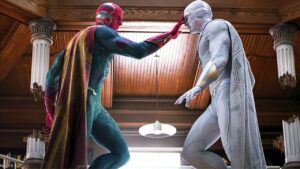
This is why the argument between Wanda and Vision at the end of Episode 5 matters far more than the Pietro reveal that originally dominated the conversation around the episode. Vision is beginning to understand that his happiness may depend on a system hurting other people. Once he has heard Norm begging for help, he cannot simply enjoy the family Wanda created without asking what that family costs.
Wanda wants to defend the home; Vision wants to know what the home is built on. That is the dramatic conflict the series needs because Vision cannot merely remain Wanda’s reward. He has to become a moral participant in the fantasy. If his continued existence requires other people to lose their freedom, then Vision himself becomes evidence against the reality keeping him alive.
There is another layer here that makes the problem even nastier. Wanda wants Vision because she loves the qualities that make him Vision: his compassion, curiosity, moral clarity and capacity to disagree with her. Yet those same qualities make him increasingly incompatible with a reality that survives only if Wanda controls the terms.
The more Vision becomes himself, the harder it becomes for Wanda to preserve the world she built to keep him.
Sparky Gives Wanda A Smaller Version Of The Finale
Sparky’s death gives Episode 5 a deceptively important rehearsal for the larger ending. Billy and Tommy want Wanda to bring the dog back, and Wanda tells them that death cannot simply be reversed because losing something is part of life. The contradiction is obvious: Wanda is explaining acceptance to her children while living inside an entire reality built around her refusal to accept Vision’s death.
But that contradiction is not sloppy writing. It reveals that Wanda already understands the truth intellectually. She knows what healthy grief is supposed to look like; she simply cannot apply the rule to the loss that broke her. That makes The Grief Bargain more painful because Wanda is not ignorant of the moral answer. She just cannot bear to live inside it yet.
The completed series eventually reveals that the Vision inside Westview is not the corpse Wanda stole and restarted. He is an expression of Wanda’s memories, love, grief and power made real inside the Hex. That makes the final choice more difficult, not less, because Wanda cannot simply tell herself that ending Westview will rescue Vision from the fantasy.
The Vision she loves exists because the fantasy exists. Ending the lie means losing him.
The Finale Finally Charges Wanda The Full Price
The finale takes the bargain Episode 5 introduces and removes every remaining excuse. Wanda confronts the people of Westview directly and experiences what her fantasy has been doing to them. At that point, preserving the family no longer exists as an abstract moral problem. Keeping Vision, Billy, Tommy and the house means keeping everybody else trapped.
So Wanda lowers the Hex, and the story finally charges the price it has been building toward. The house disappears, Billy and Tommy disappear, and Vision disappears. Wanda loses the family Westview allowed her to create because releasing the people trapped inside her grief requires releasing the fantasy as well.
This is why the ending works as the completion of The Grief Bargain. The story does not punish Wanda merely because she wanted something impossible. It forces her to decide whether the thing she wants remains worth having once she understands who is paying for it.
Wanda chooses to pay the bill herself.
So What Is The Cost Of Wanda’s Lie?
The lie costs Norm his freedom and forces the people of Westview into lives they did not choose. It costs Monica the experience of carrying Wanda’s grief from inside the Hex, and it costs Vision his trust in the reality around him. Eventually, the lie costs Wanda the family she created to escape the original loss because the only way to restore everybody else’s freedom is to surrender the fantasy completely.
That is what makes Westview seductive instead of simply evil. The lie works for a while. Wanda really does get more time with Vision. She really does experience motherhood. There really are dinners, arguments, bedtime routines and ordinary moments that death had made impossible.
A bargain is only dramatic if the thing being purchased is worth wanting.
Why The Evan Peters Misdirect Still Works
Removing the old multiverse theory does not make the Evan Peters casting meaningless. It simply changes what the casting is doing. For an audience familiar with the Fox X-Men movies, Peters arrives carrying enormous recognition, and the episode encourages us to do exactly what Wanda wants to do: see somebody familiar and briefly accept the impossible return because the emotional promise feels too good to reject.
Even Wanda knows something is wrong, but grief creates the opening. The face is familiar enough that resurrection becomes tempting, and for a moment the audience participates in the same bargain Wanda keeps making. We want the impossible explanation to be true because the alternative is accepting that Pietro is still gone.
That makes the misdirect more useful in retrospect than the old crossover theory ever was. The audience does not merely watch Wanda fall for the possibility of getting somebody back; the casting makes us feel the temptation too.
Why WandaVision Still Matters To Avengers: Doomsday
The MCU has become considerably more complicated since WandaVision aired. We now have variants, alternate universes, incursions, rewritten timelines and characters whose lives have changed because somebody interfered with the structure of reality. But WandaVision remains useful because it asks the smaller human question underneath all of those mechanics: just because reality can give something back, does that mean keeping it is morally free?
That is where the episode connects to Doctor Doom’s “stolen lives” argument in Avengers: Doomsday. Doom becomes dramatically interesting if he can identify a real pattern without automatically earning the authority to dictate the solution. Marvel characters keep finding ways to resist endings that reality appeared to make permanent, and Wanda is one of the clearest emotional examples of why somebody would desperately want to do that.
She has lost her parents, her brother and Vision. She was erased by the Blip, returned, and discovered that the person she loved was still dead. When an impossible domestic life finally appears, Wanda does not want to surrender it because some cosmic rule says the ledger is out of balance. To her, Vision is not an anomaly. He is Vision.
But WandaVision also prevents the opposite argument from becoming comfortable. Wanda’s love does not make Norm’s suffering less real, and grief does not grant her unlimited authority over everybody else’s life. Sometimes resisting loss can be heroic. Sometimes refusing loss simply transfers the cost to someone else.
The difficult question is determining the difference.
The Grief Bargain
- The reward: Wanda gets Vision, children, a home and the ordinary family life reality denied her.
- The first cost: Norm reveals that real people are suffering beneath the sitcom.
- The moral pressure: Vision realizes his happiness depends on a system hurting other people.
- The rehearsal: Sparky forces Wanda to explain why death cannot simply be undone.
- The crisis: Wanda can preserve her family or free Westview, but she cannot do both.
The Lesson For Avengers: Doomsday
If Doomsday intends to put altered lives and collapsing realities on trial, then WandaVision is a useful old receipt because it already asked the question that matters: who pays for the reality a character wants to preserve? That is where a cosmic argument becomes human. A scientist can explain the mechanics, Doom can talk about stolen lives, and an incursion can put billions of people on the board, but story happens when one character looks at the life they are being asked to surrender and knows exactly what losing it means.
Wanda knew. That is why she remains useful to this larger MCU argument, but it is also why she cannot simply become evidence that Doom is correct. Westview is wrong because Wanda’s solution removes other people’s agency, not because loving someone who was supposed to stay dead is itself a moral failure.
The human cost has to stay in the argument. Otherwise, the story becomes cosmic accounting instead of drama.
Quick FAQ
Did Wanda Steal Vision’s Body In WandaVision?
No. Episode 5 encourages the audience to suspect that Wanda broke into S.W.O.R.D. and stole Vision’s remains, but later episodes reveal that she left the facility without taking the body. The Vision inside Westview is created as part of Wanda’s Hex rather than being the stolen corpse of the original Vision.
Was Evan Peters Really The X-Men Quicksilver In WandaVision?
No. His casting deliberately plays on the audience’s familiarity with Peters as Quicksilver in the Fox X-Men films, but WandaVision does not ultimately reveal him to be that character crossing into the MCU. The original version of this article was written after Episode 5 and incorrectly predicted that the appearance confirmed a multiverse crossover.
Is Wanda Controlling Everyone In Westview?
Wanda creates and maintains the Hex, and the people trapped inside it experience her grief while being forced into the reality surrounding her family. The completed series also reveals that Agatha Harkness is manipulating events within Westview, so Wanda is not consciously directing every strange occurrence. That does not remove Wanda’s responsibility for preserving the Hex once she understands that people are suffering inside it.
Why Is Norm Important In WandaVision Episode 5?
Norm gives Vision direct proof that a real person exists beneath the sitcom character. His panic turns Westview from a mysterious fantasy into an ethical problem because Vision can no longer enjoy his life there without confronting what the reality is doing to other people.
What Is The Main Theme Of WandaVision Episode 5?
Episode 5 asks whether grief can justify preserving a comforting reality once that comfort begins costing other people their freedom. It is the point where Wanda’s fantasy increasingly becomes a moral choice rather than simply a mystery.
Continue The WandaVision Story
- WandaVision Episode Guide: all nine episodes and the story threads Marvel actually carried forward
- Why Is WandaVision A Sitcom? The television format as Wanda’s defense mechanism
- WandaVision Is About Grief — But Its Real Story Is About Control
- Is WandaVision Season 2 Happening? Why VisionQuest is the continuation you are actually looking for
- Who Is White Vision? What happened after WandaVision and why his identity still matters
From Westview To Doomsday
The MCU is still wrestling with lives, relationships and realities that refuse to stay lost. Continue with our Doctor Doom “Stolen Lives” analysis, follow the larger Road to Avengers: Doomsday, or use our Marvel MCU Guide to explore the larger board.
What Is The Cost Of Wanda’s Lie?
Episode 5 begins the argument by letting Vision hear the person trapped underneath Wanda’s perfect sitcom. Norm’s fear turns Westview from a private refuge into The Grief Bargain: Wanda can keep the family reality denied her, but other people are being forced to carry the cost. By the finale, that same bargain has scaled all the way to Wanda herself, because releasing Westview means surrendering Vision, Billy, Tommy and the home she built around them.
That is the craft lesson that survives long after the old Pietro theories are gone. A powerful lie becomes dramatic when it gives a character something genuinely worth wanting and then forces the story to reveal who has been paying for it. The stronger the desire, the more painful the final choice becomes when the cost can no longer be ignored.
Wanda’s grief is not the sin. Making everyone else live inside it is.