Full spoilers for all nine episodes of WandaVision follow.
Short answer: yes, WandaVision is absolutely a story about grief. But grief is the wound, not the dramatic action. The thing Wanda actually spends most of the series doing is controlling the world around her so she never has to feel powerless in the face of loss again.
That distinction changes the entire show. Wanda does not create Westview simply because she is sad. She creates a world where Vision is alive, the family stays together, uncomfortable moments can be rewritten and anybody who threatens the fantasy can be removed. Her grief explains why she needs the Hex; her need for control explains what she does once she has it.
My thesis is that WandaVision runs on what I’m calling the Control Bargain: Wanda protects herself from the pain of losing the people she loves by taking away everyone else’s ability to choose.
Go deeper into Westview: Our WandaVision episode guide connects every episode, White Vision, Billy and Tommy, Agatha and the story threads Marvel carried beyond the Hex.
WandaVision Is About Grief — So Why Does Control Matter More?
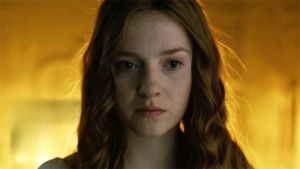
Grief explains Wanda’s condition at the beginning of the story. She has lost her parents, Pietro and Vision, and the empty lot in Westview represents a future with Vision that she never gets to live. When her magic finally explodes outward, the town becomes a physical expression of a person who cannot absorb one more permanent loss.
But a wound is not the same thing as a dramatic strategy. Once Westview exists, Wanda has choices about how she responds whenever reality threatens it. Again and again, her answer is not simply to mourn. Her answer is to control.
She rewrites moments that frighten her. She changes the environment when the old version stops working. She decides which facts can exist inside the Hex. She assigns roles to people who never volunteered for them. When Vision begins resisting the reality she has created, even the person Wanda most desperately wants to love freely becomes somebody whose freedom threatens her.
That is the Control Bargain. Wanda cannot control death, so she starts controlling everything death left behind.
The Beekeeper Scene Shows Wanda Choosing Control Almost Immediately
At the end of Episode 2, Wanda and Vision step outside and see a strange figure climbing out of the sewer. At this point, neither Wanda nor the audience fully understands what Westview is, but Wanda understands one thing immediately: this does not belong in the reality she wants.
So she says no.
The scene rewinds. The intrusion disappears. Wanda and Vision return to the safe version of the story, and the world shifts into color. It is an early moment, but it tells us something essential about how Wanda responds when the fantasy becomes unstable.
She does not investigate the thing she does not understand. She does not allow the threat to remain long enough to discover what it means. She uses power to restore the version of reality that feels safer.
That is a small act of control compared with what comes later, which is why it works so well as the first proof. The action seems almost harmless. Wanda is scared, the world is strange and the unwanted thing disappears. But the mechanism is already there: when reality produces something painful or threatening, Wanda believes she has the right to edit reality instead of experiencing it.
Monica Turns The Control Bargain From Private Defense Into Harm
Monica Rambeau changes the moral scale of the problem because she introduces a fact Wanda cannot simply absorb. Inside Westview, Monica has been given the role of Geraldine. She can participate in the fantasy as long as she behaves like somebody who belongs there.
Then she mentions Pietro’s death.
The important thing is not merely that Wanda becomes upset. Wanda has every reason in the world to be hurt by the memory of her brother. The important thing is what she does with that hurt. She identifies Monica as a threat to the reality she has constructed and physically ejects her from Westview.
The Control Bargain has become more expensive. Wanda’s protection from grief now requires another person to lose agency, safety and even the right to remain in the room when she says something Wanda does not want to hear.
This is why “WandaVision is about grief” can become incomplete if we stop there. Grief makes Wanda sympathetic. Control makes the story morally difficult.
The show is not asking whether Wanda deserves to feel devastated. Of course she does. It is asking how much harm somebody is allowed to cause while trying to make devastation stop.
Vision Turns Wanda’s Need For Control Into A Relationship Problem
Vision is where the argument becomes personal instead of abstract. Wanda did not create Westview because she wanted power over Vision. She created it because she wanted Vision back. Yet the version of Vision who gradually emerges inside the Hex begins asking questions, investigating the town and recognizing the suffering underneath Wanda’s perfect life.
That creates the central contradiction of Wanda’s strategy. She wants Vision because of the qualities that make him Vision: his moral clarity, his curiosity, his compassion and his ability to disagree with her. But those same qualities make him impossible to contain inside a fantasy whose survival depends upon nobody challenging Wanda’s authority over reality.
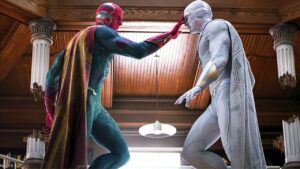
Episode 5 makes that conflict impossible to ignore. Vision confronts Wanda about Norm, the people of Westview and the extent of her control. Wanda tries to end the argument by rolling the credits, literally using the grammar of her television world to declare that the conflict is over.
Vision refuses to accept the ending.
That is a terrific piece of storycraft because the relationship and the mechanism become the same problem. Wanda has built a world so she can have Vision, but keeping the world requires her to silence the independent Vision standing in front of her.
The Control Bargain has trapped Wanda inside its contradiction: the more completely she controls the person she loves, the less meaningful it becomes to say that he loves her back.
Expanding The Hex Shows How Far Wanda Will Go To Avoid Losing Vision Again
The escalation reaches its clearest point when Vision attempts to leave Westview. Outside the Hex, his body begins coming apart. Wanda sees the exact nightmare she has built this entire reality to prevent: Vision is dying in front of her again.
And Wanda responds by expanding the Hex.
This is the Control Bargain at its most seductive because her motivation is completely understandable. She is not expanding Westview because she wants a bigger kingdom. She is trying to save somebody she loves. The problem is that saving Vision means consuming more people, more territory and more lives inside the reality he is already telling her is wrong.
That is what strong dramatic pressure does. It does not make a character choose between an obviously good option and an obviously evil one. It makes the harmful choice feel emotionally reasonable enough that we understand why the character keeps making it.
Wanda wants to save Vision. Every step toward saving him also deepens the thing Vision wants her to stop doing.
The People Of Westview Force Wanda To See The Cost Of Her Control
The finale finally removes the distance between Wanda’s intention and everybody else’s experience. When Agatha releases the people of Westview from Wanda’s control, they confront Wanda directly with what life inside her fantasy has felt like. Her grief has not disappeared inside the Hex. It has spread.
This is the crisis the Control Bargain has been moving toward from the beginning. Wanda believed control could contain pain. Instead, control redistributed the pain onto everybody who had to surrender their own lives to maintain her comfort.
Her first instinct is still defensive because she genuinely does not want to believe she has become the source of this suffering. But once the truth becomes unavoidable, the choice finally changes. Wanda can preserve the family she created, or she can restore everybody else’s freedom.
She cannot do both.
That is why lowering the Hex matters more than simply defeating Agatha. Becoming more powerful does not resolve Wanda’s character problem. Giving up power does.
Wanda’s Real Victory Is Choosing Not To Control The Ending
Taking down Westview means accepting exactly what Wanda has spent the series trying to prevent. Billy and Tommy disappear. Vision disappears. Their house disappears. Wanda cannot rewrite the scene, remove the person delivering bad news or expand the Hex far enough to keep the family alive.
She has to let the ending happen.
That is what makes the final goodbye with Vision work. Wanda does not stop loving him. She does not decide her grief was foolish. She does not somehow become immune to losing him again. The change is that she no longer makes the rest of the world surrender its freedom so she can avoid experiencing that loss.
The grief remains. The control does not.
That is a much more specific character arc than simply saying Wanda moves through the stages of grief. She begins with unbearable loss and discovers a supernatural way to remove uncertainty from her world. The story then keeps raising the moral cost of that certainty until she finally has to decide whether love can still be love when everybody else has lost the ability to choose.
The Control Bargain
- The wound: Wanda cannot bear another permanent loss.
- The strategy: she controls reality so loss cannot reach her.
- The escalation: maintaining that protection requires more people to surrender their own choices.
- The contradiction: controlling Vision destroys the very freedom that makes their relationship meaningful.
- The crisis: Wanda must choose between keeping her family and releasing Westview.
Why Control Makes WandaVision More Interesting Than A Simple Grief Story
None of this diminishes the grief reading. Grief is everywhere in WandaVision, and the show would collapse without it. But grief gives Wanda a wound; control gives the story movement.
That is why the Hex can keep escalating instead of merely illustrating how sad Wanda feels. Every time reality pushes against her, Wanda has to decide whether she will accept what she cannot control or tighten her grip on the world. The decisions get larger because the consequences of control keep getting larger.
This is also why the story lands on a moral question rather than a therapeutic one. The climax is not “Has Wanda finished grieving?” She obviously has not. The climax is whether Wanda can allow grief to exist without making everybody else live inside it with her.
That question has teeth because there is no version of the answer where Wanda gets everything she wants. Freedom means loss. Control means keeping the people she loves while transforming that love into captivity.
Now we have a story.
How The Sitcom Fits Into Wanda’s Need For Control
This is where the control argument connects to the sitcom without duplicating it. The television format is the shape Wanda gives her defense mechanism; control is the action required to keep that defense intact.
The sitcom gives Wanda a world where family conflict is temporary, home is stable and everybody can return for another episode. But once reality begins violating those rules, the fantasy does not maintain itself. Wanda has to rewind scenes, remove intruders, alter roles and eventually control an entire town to keep the story functioning.
So the two ideas reinforce one another. The sitcom is the shield. Control is what Wanda does every time somebody tries to get through it.
You can read the full breakdown of that device in our Why Is WandaVision A Sitcom? analysis.
Keep Going Through WandaVision
- WandaVision Episode Guide: all nine episodes, the ending and the story threads Marvel actually carried forward
- Why Is WandaVision A Sitcom? why the television format functions as Wanda’s defense mechanism
- Is WandaVision Season 2 Happening? why VisionQuest is the continuation you are actually looking for
- Who Is White Vision? what he remembers and whether memories are enough to make him Vision
- VisionQuest Marvel Guide: follow Vision, Tommy, Ultron and the next branch of the Westview story
- Marvel MCU Guide: explore the larger Marvel story board
WandaVision Is About What Grief Makes Wanda Try To Control
We started with the difference between Wanda’s wound and Wanda’s strategy. Grief explains why Westview exists, but the Control Bargain explains what turns that grief into drama: Wanda keeps trading somebody else’s freedom for one more chance to avoid losing the people she loves.
The first proof is small enough to feel almost harmless when Wanda rewinds the beekeeper out of her story. By the crisis, the same instinct has expanded until an entire town is trapped and Wanda must choose between everybody else’s autonomy and the family she built the Hex to preserve. That is the transferable craft lesson: a wound becomes a story when the character’s solution creates a cost large enough that they eventually have to choose between the protection and the person they want to become.
Grief built Westview. Control kept it standing. Healing begins when Wanda lets it fall.