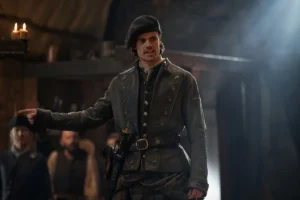
Full spoilers for Outlander: Blood of My Blood Season 1 and the original Outlander television series follow. No future book spoilers.
Colum and Dougal MacKenzie are fighting because they love the same clan but fundamentally disagree about what leadership requires. Colum believes Clan MacKenzie survives through restraint, political calculation, authority, and knowing when not to fight. Dougal increasingly believes survival requires courage, action, force, and a willingness to move when everyone else is still debating the consequences.
Season 1 initially makes that conflict look like a succession fight between two brothers after Red Jacob dies. But by the end of the season, it becomes something much bigger.
The real problem is not which brother gets to lead Clan MacKenzie. It is what happens when both men believe their version of loyalty gives them the right to decide the clan’s future.
Quick Answer
Colum and Dougal are brothers competing over leadership, authority, and what Clan MacKenzie needs to survive.
Season 1 resolves the immediate succession crisis by making Colum the laird and Dougal his war chieftain. But that arrangement divides political authority from military power without resolving the brothers’ deeper disagreement. Colum wants restraint and control. Dougal wants action and increasingly believes some causes are important enough to act without Colum’s permission.
Where The Colum And Dougal Fight Begins
The conflict explodes after the death of their father, Red Jacob MacKenzie. Clan MacKenzie suddenly needs a new laird, and neither brother has an uncontested claim to the kind of leadership the clan expects.
Colum is the more politically disciplined brother. He understands alliances, succession, money, appearances, and the danger of allowing the clan to fracture. But his physical disability means he cannot personally fulfill the traditional warrior role expected of a Highland chief.
Dougal has the opposite problem. He looks and behaves like the kind of man warriors might instinctively follow. He is physically capable, charismatic, courageous, and comfortable using force. But he is also impulsive, proud, and increasingly willing to act before everyone else has agreed that action is wise.
Each brother therefore possesses something the other lacks.
And each knows it.
Red Jacob Helped Create The Rivalry Between His Sons
“School of the Moon” makes clear that Colum and Dougal did not suddenly become competitive adults after their father died. Their rivalry was cultivated inside the family long before either man had a realistic chance of becoming laird.
Red Jacob measures his sons differently and repeatedly places them inside a system built around comparison, masculine expectation, punishment, and approval. Colum learns to seek legitimacy through responsibility and control. Dougal learns to seek validation through courage, toughness, and action.
That history matters because both brothers enter the succession fight carrying an old wound.
Neither is simply asking, Who would make the better laird?
Some part of each man is still asking:
Which one of us was our father actually proud of?
Why Colum Wants To Be Laird
Colum’s claim to leadership is about more than ambition. Becoming laird allows him to prove that his body does not determine whether he is capable of leading the clan.
He cannot become Dougal physically, so he builds power somewhere else. Colum learns to observe people, calculate consequences, negotiate, gather information, and understand the political machinery beneath whatever crisis is currently sitting in front of him.
That is the beginning of the Colum we eventually meet in Outlander.
He does not need to be the most dangerous man holding a weapon in the room if he can become the man everyone acknowledges has the authority to decide whether the weapons come out at all.
Read our complete Colum MacKenzie guide →
Why Dougal Wants More Than A Title
Dougal’s hunger is slightly different.
He wants recognition that the things he is good at matter. Courage matters. Physical capability matters. The willingness to ride into danger matters. The ability to make other men follow you matters.
And Dougal is not entirely wrong.
A clan living inside the political and military instability of early 18th-century Scotland cannot survive through diplomacy alone. At some point, somebody has to command men in the field.
The danger is that Dougal gradually begins treating his willingness to act as evidence that his judgment must also be correct.
He trusts the intensity of his convictions.
That becomes one of the defining traits of the man we later meet in Outlander.
Read our complete Dougal MacKenzie guide →
Why Colum Becomes Laird And Dougal Becomes War Chieftain
Episode 3 finds an elegant solution to the immediate succession crisis.
It also creates a relationship that is almost guaranteed to become unstable.
With James MacKinney threatening to exploit the division inside Clan MacKenzie, Ned Gowan recognizes that Colum and Dougal are about to lose everything while arguing over which one of them should have everything.
The solution is co-leadership.
Colum becomes laird of Clan MacKenzie. Dougal becomes his war chieftain.
Colum receives formal political authority. Dougal becomes the brother responsible for representing that authority in battle and in the field.
On paper, it is almost perfect.
Colum has the judgment but cannot physically lead warriors into battle. Dougal can lead warriors into battle but benefits from someone capable of restraining his worst impulses. Together, the brothers can theoretically operate like one complete leader.
The problem is that a political compromise can divide responsibilities.
It cannot erase resentment.
The Compromise Solves The Succession Crisis, Not The Brothers
That distinction is the key to understanding Colum and Dougal.
Episode 3 resolves the structural question of who holds which position. It does not resolve the emotional or philosophical question underneath it.
Colum still believes political authority ultimately belongs to the laird.
Dougal still possesses independent influence, armed men, physical charisma, and increasingly strong political convictions of his own.
One brother gets the chair.
The other gets the army.
That can work only while both men agree about where the clan should go.
Eventually, they do not.
Colum And Dougal Have Different Definitions Of Loyalty
This is where their relationship becomes much more interesting than sibling jealousy.
Both men believe they are loyal to Clan MacKenzie.
Colum understands loyalty through responsibility. If he is laird, then every political gamble has consequences for people who did not personally choose to take that gamble. His job is therefore to think beyond the glory of a cause and ask what happens to the clan if the cause fails.
Dougal understands loyalty more emotionally. Scotland, the MacKenzies, family honor, courage, and eventually the Jacobite cause begin collapsing into a single identity. Refusing to act can therefore feel like cowardice or betrayal.
That creates the central contradiction:
Colum can believe Dougal is endangering Clan MacKenzie while Dougal believes Colum is failing Clan MacKenzie.
Both brothers can understand themselves as the loyal one.
Episode 7 Shows Why Their Arrangement Cannot Stay Simple
By “Luceo Non Uro,” the argument is no longer merely theoretical.
Dougal attends a clandestine political meeting that could create serious consequences for Clan MacKenzie. The important part is not simply that Dougal has political beliefs of his own.
The important part is that he is willing to pursue them independently.
That pushes directly against the arrangement established in Episode 3.
Dougal may be war chieftain, but Colum is still laird. If Dougal can make political decisions that risk the clan without Colum’s approval, then the division of responsibility stops being a partnership and starts becoming a competing government.
And Dougal can justify it to himself because he does not believe he is betraying Clan MacKenzie.
He believes he is fighting for something Colum is too cautious to defend.
The Jacobite Cause Makes Their Differences Impossible To Ignore
The original Outlander eventually makes the political divide unmistakable.
Dougal becomes passionately committed to the Jacobite cause. Colum remains far more cautious about tying the future of Clan MacKenzie to a rebellion that could destroy everything he is responsible for protecting.
Again, neither question is ridiculous.
Dougal asks whether Scotland and the Stuart cause are worth fighting for.
Colum asks what happens to the MacKenzies if they lose.
That is the difference between being willing to die for something and being responsible for everyone who may have to die with you.
Dougal experiences caution as weakness.
Colum experiences impulsiveness as danger.
And because both men have enough evidence to support their own worldview, neither one ever has to believe he is the problem.
Ellen Gets Trapped Inside Their Leadership Fight
Their sister Ellen makes the consequences of the brothers’ political thinking personal.
Colum and Dougal both love her. But once the MacKenzie succession becomes unstable, Ellen’s marriage becomes another resource that can be used to solve a clan problem.
Her proposed marriage to Malcolm Grant can repair an alliance, provide political stability, and strengthen the position of the new MacKenzie leadership.
All of that makes sense if you are looking at Ellen as a piece on the clan board.
Ellen has the irritating habit of remembering that she is a person.
That forces both brothers to confront something uncomfortable: loving their sister does not automatically mean respecting her right to decide what happens to her own life.
Colum and Dougal may disagree about leadership, but both men are capable of justifying control when they believe the survival of the family requires it.
Why Ned Gowan Matters To The MacKenzie Brothers
Ned becomes valuable precisely because he is not another version of either brother.
He understands structure.
When Colum and Dougal become trapped inside the emotional argument over who deserves to lead, Ned sees the external threat: if they keep dividing MacKenzie support, somebody else can take advantage of it.
That is why the war-chieftain compromise works.
Ned does not magically repair the relationship.
He designs a system capable of functioning despite the relationship.
And that tells us something about the Castle Leoch we eventually see in Outlander. The MacKenzie leadership structure is not proof that Colum and Dougal solved their problems.
It is the mechanism everyone built because they knew the problems were not going away.
Blood Of My Blood Makes Their Outlander Relationship Sadder
When Claire arrives at Castle Leoch in the original series, the hierarchy already feels established.
Colum is the laird.
Dougal is the war chieftain.
We accept those roles as facts about the world.
Blood of My Blood turns those facts back into choices.
Now we know the title split came from a moment when the brothers were close enough to kneel before each other and promise that they could make the arrangement work.
That makes everything later more painful.
The resentment did not exist because the brothers never loved each other.
It survived despite the fact that they did.
How Colum And Dougal Connect To Jamie Fraser
Both men are Jamie’s maternal uncles through his mother, Ellen MacKenzie. That makes their conflict part of the family and political world Jamie eventually inherits.
And Jamie is interesting partly because he seems capable of carrying strengths from both men.
He can fight like Dougal.
He can read a political room like Colum.
He can inspire loyalty through physical courage while also understanding that leadership sometimes means refusing the fight everyone expects you to take.
That does not mean Jamie is simply a perfect combination of his uncles.
But Blood of My Blood makes it much easier to see the leadership traditions surrounding Ellen’s future son before he is even born.
See how Colum and Dougal fit into the complete Blood Of My Blood family tree →
So Why Are Colum And Dougal Really Fighting?
Because they represent two different answers to the same question.
What does a leader owe his people?
Colum believes leadership requires discipline, authority, patience, and the willingness to restrain your own desires because the consequences belong to everyone.
Dougal believes leadership requires courage, conviction, action, and the willingness to risk something meaningful when caution becomes another word for fear.
Both philosophies contain something Clan MacKenzie needs.
Both become dangerous when pushed too far.
That is why their Episode 3 compromise is simultaneously brilliant and doomed.
The MacKenzies find a way to use both brothers’ strengths.
They never find a way to make the brothers agree about which strength should matter most.
Colum thinks leadership means knowing when not to draw the sword.
Dougal thinks there are moments when refusing to draw it is the greater betrayal. Everything that follows grows out of that difference.
Keep Going
More Clan MacKenzie & Blood Of My Blood
Colum And Dougal FAQ
Why are Colum and Dougal fighting in Blood Of My Blood?
Colum and Dougal are fighting over leadership, authority, and the future of Clan MacKenzie. Colum favors political control and caution, while Dougal increasingly favors direct action and believes his own convictions may justify acting independently.
Are Colum and Dougal brothers?
Yes. Colum and Dougal are brothers, sons of Red Jacob MacKenzie, and brothers to Ellen, Jocasta, and Janet MacKenzie.
Why does Colum become laird instead of Dougal?
Season 1 resolves the succession crisis through a divided leadership structure. Colum becomes the formal laird because of his political and diplomatic strengths, while Dougal becomes war chieftain and leads the clan in the field.
Who comes up with the Colum and Dougal compromise?
Ned Gowan helps broker the solution after recognizing that the brothers’ rivalry is allowing an outside challenge to threaten MacKenzie control. The arrangement combines Colum’s political leadership with Dougal’s military strengths.
What is a war chieftain?
Within the structure established by Blood of My Blood, Dougal serves as the clan’s military leader under Colum’s broader authority as laird. This allows Dougal to lead men in the field where Colum physically cannot.
Does Dougal obey Colum?
Dougal formally pledges loyalty to Colum when their leadership arrangement is established, but Season 1 quickly shows the limitations of that promise. Dougal increasingly pursues political convictions that can put him at odds with Colum’s authority.
Why does Dougal attend the secret meeting?
Dougal’s participation in the clandestine meeting reflects his growing political convictions and willingness to act independently when he believes the cause justifies it. The decision threatens to create serious political consequences for Clan MacKenzie.
Are Colum and Dougal Jacobites?
Dougal becomes the much more committed Jacobite of the two. Colum is more cautious about risking Clan MacKenzie for the cause, creating one of the major political divisions between the brothers.
How are Colum and Dougal related to Jamie Fraser?
Both are Jamie Fraser’s maternal uncles. Their sister Ellen MacKenzie is Jamie’s mother.
Why does their Blood Of My Blood story matter to Outlander?
The prequel shows how the leadership structure already in place when Claire reaches Castle Leoch was created. It also gives the later resentment between Colum and Dougal a history built from childhood competition, genuine brotherly love, divided authority, and fundamentally different ideas about leadership.