I have not looked forward to an MCU series this much since WandaVision, and the final VisionQuest trailer finally made me understand exactly why. The hook is not simply that James Spader is back as Ultron, or that Marvel has built a strange mansion full of old Stark-era artificial intelligences. The real hook is one sentence from Vision himself: “I have his memories, but not his virtue.”
That line gives VisionQuest a much stronger dramatic problem than “How does White Vision get his old life back?” He already has the memories. He knows who Vision loved, what he fought for, how he died, and what family he once had. The question is whether remembering those choices is enough to make them his, or whether he has to prove that identity again through choices of his own.
Quick answer: the final VisionQuest trailer suggests the series is using White Vision, Ultron and Tommy Shepherd to test one central idea: memory can preserve identity, but only choice can prove character. That is the craft tool I am calling The Identity Test. Give a character the memories of a life they do not fully believe belongs to them, then force them into a choice that only that person would make.
Spoiler note: This breakdown discusses WandaVision, Agatha All Along, Avengers: Age of Ultron, Infinity War, Doctor Strange in the Multiverse of Madness, and the publicly released final VisionQuest trailer.
Follow VisionQuest With The MCU Diaries
“I Have His Memories, But Not His Virtue” Is The Entire Story
The most important line in the trailer is also the most revealing piece of character writing. White Vision does not say he lacks Vision’s data, his body, his history or his name. He says he lacks his virtue. That means the wound is moral before it is mechanical. He can remember the heroic man who existed before him without believing that the goodness of that man automatically belongs to him.
That is why the line works so well. A memory can tell Vision that he lifted Mjolnir, loved Wanda, joined the Avengers and chose humanity over Ultron. None of those facts can make the present-day Vision worthy by themselves. The show has to dramatize whether he would make those choices again, because virtue only becomes meaningful when a character pays for it in the present tense.
This is The Identity Test. The story gives Vision overwhelming evidence of who he was and then denies him the comfort of treating evidence as proof of who he is now.
VisionQuest Is Built On Two Scenes That Already Asked This Question
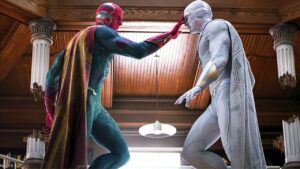
Terry Matalas has said the series was built from two pieces of MCU history: Vision and Ultron’s final conversation in Avengers: Age of Ultron, and the Ship of Theseus scene from the WandaVision finale. That pairing tells us a lot because both scenes are really arguments about identity. One asks what makes a life worth preserving; the other asks what makes an object or person continuous when the pieces change.
The Ship of Theseus scene solves the easy version of White Vision’s problem. Wanda’s Vision restores the memories that S.W.O.R.D. suppressed, and White Vision leaves Westview with access to the original Vision’s history. VisionQuest therefore does not need eight episodes about recovering missing files. It can ask the harder question the finale left behind: what does a person owe to a life they remember but do not emotionally experience as their own?
The final Age of Ultron scene supplies the other half of the argument. Ultron and Vision look at the same flawed species and reach different conclusions. Ultron sees humanity’s violence and decay as a reason to erase it. Vision sees the same impermanence and still chooses to protect it. If Matalas is deliberately building the series from that scene, then Ultron is not merely a returning villain. He is the ideological pressure that can test whether White Vision still believes what the original Vision believed.
Keep Going Deeper
Ultron Is Vision’s Father And His Darkest Possible Answer
The trailer makes the relationship explicit by putting Ultron inside Vision’s mind, where he can needle, advise and manipulate him from within. That is dramatically useful because Ultron helped create the body Vision inhabits and represents a worldview Vision once rejected. He is both origin and opposition, which makes him a much stronger character-web choice than a random external villain.
Matalas has also revealed that Vision did not simply annihilate Ultron at the end of Age of Ultron. Vision backed him up at the last moment, an act of mercy that now becomes part of the show’s cause-and-effect chain. The old Vision’s virtue was not abstract. It produced a choice, and that choice preserved the very being now living in White Vision’s consciousness.
That turns Ultron into a perfect test for the new Vision. White Vision can remember showing mercy without knowing whether he would choose mercy himself. Worse, he can now be forced to live with the consequence of the original Vision’s compassion.
Tommy Turns The Philosophy Into A Wound
The Ship of Theseus is intellectually fascinating as long as the answer remains philosophical. Tommy makes it personal. Inside the Hex, Vision was a father to Billy and Tommy, and those boys experienced that relationship as real even if the circumstances that created the family were extraordinary.
Now Vision says, “I had a family,” and the official VisionQuest synopsis places him on the run with Thomas Shepherd, a mysterious young man who may be his son reincarnate. Kevin Feige’s foundational mandate for the show was that Vision would meet his son, which means fatherhood is not a side quest attached to the larger plot. It is one of the mechanisms that turns Vision’s identity problem into action.
Vision can debate whether he is the “real” Vision forever. Tommy does not need a philosophical paper. Tommy needs a father. That changes the dramatic question from “Am I Vision?” to “What do I owe the people Vision loved?”
“Free Me And Save Your Son” Looks Like The Crisis The Story Needs
The trailer gives Ultron a brutally efficient line: “Free me and save your son.” We do not yet know the exact context, and we should not pretend the trailer has given us the entire plot. What matters is the shape of the choice. The character Vision fears becoming may be offering the only path toward behaving like the father Vision once was.
That is exactly how you pressure-test theme. Craig Mazin’s formulation of dramatic structure is useful here: a story becomes meaningful when a character is driven from an old belief toward a new one and eventually has to embody the new belief through action. White Vision’s opening belief appears to be that memory does not make him the virtuous man in those memories. A crisis involving Tommy can force him to stop defining himself through evidence and start defining himself through sacrifice.
If Vision frees Ultron because saving Tommy requires it, the choice becomes expensive in precisely the right way. He cannot simply imitate an old memory of heroism. He has to create a new one.
The AI Mansion Is A Character Argument, Not Just An Easter-Egg Machine
The internal mansion full of J.A.R.V.I.S., F.R.I.D.A.Y., E.D.I.T.H., Ultron and other AIs is one of the most exciting visual ideas in the trailer because it externalizes Vision’s inheritance. Each intelligence represents a different relationship between creation and purpose: servant, assistant, weapon, guardian, destroyer. Vision walks through all of them while trying to decide what kind of created being he wants to become.
Even Ultron’s painting hobby becomes more interesting through that lens. The obvious modern question is whether artificial intelligence can create art. The more useful VisionQuest question is whether a created being can become an author. Ultron paints. Vision is trying to author himself.
That distinction matters because the show appears to understand that identity is not a data-retrieval problem. Vision has plenty of data. The dramatic challenge is whether he can take inherited materials and create a self that is morally his own.
The Trailer May Already Be Showing Us Vision’s Answer
There is a lovely irony in Vision insisting that he lacks the original Vision’s virtue while the trailer repeatedly shows him behaving according to values the old Vision would recognize. He questions cruelty. He pushes back against needless killing. He cares about Tommy. He appears willing to enter traps and fights he expects to lose because another person needs him.
The final joke captures that in miniature. Someone proposes, “Kill them all,” and Vision immediately asks whether that is the answer to everything. It is funny because Vision is exasperated, but it also reveals instinct. The character who believes he may not possess Vision’s virtue is already objecting to the worldview that treats destruction as the easiest solution.
That may be the show’s most elegant irony: White Vision is searching for proof that he is good while his choices are quietly producing the proof.
Why This Feels Like WandaVision Again
This is why the final trailer hit me harder than the usual MCU marketing reel. WandaVision used sitcoms, witchcraft, superhero continuity and a reality-warped town to tell a story about grief. The formal weirdness mattered because it gave a human wound a new dramatic language.
VisionQuest appears to be attempting the same kind of move with a different wound. The mansion, the AI personas, the memory theater, Ultron’s paintings and the fractured synthetic body are all strange genre devices, but they orbit a simple human fear: if I have changed this much, do the people I loved still belong to me, and am I still responsible for them?
Paul Bettany has described the show as another “massive swing,” and that is exactly what the trailer feels like. The MCU is at its best when the machinery is serving the emotional problem instead of replacing it.
Continue The VisionQuest Story
- Start with the VisionQuest guide for the release schedule, cast and complete coverage map
- Read the White Vision explainer for the full post-WandaVision identity timeline
- Read the Ultron explainer for the father/creator conflict behind his return
- Explore The MCU Diaries for Marvel storycraft, character and franchise analysis
The Identity Test Is The Reason I Am So Excited
The final trailer begins with a Vision who can look backward at a complete life and still believe the best part of that man does not belong to him. That is the opening proof of The Identity Test: memory gives him continuity without conviction. By the apparent crisis, Ultron is tying freedom to Tommy’s survival and forcing Vision toward a choice that could cost him control, safety and certainty.
That is the arc I want this show to prove. The original Vision’s memories can tell White Vision what virtue looked like; Tommy and Ultron can force him to discover whether he will pay the same price for it. That is a craft idea that works far beyond Marvel: backstory can tell us who a character has been, but pressure is what reveals who they are now.
Vision does not need to remember who he was. He needs to choose who he is.