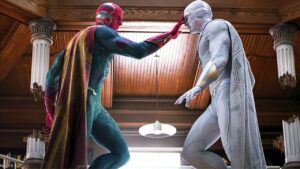
Ultron is in VisionQuest because Vision never completely erased him. Showrunner Terry Matalas has revealed that the final confrontation in Avengers: Age of Ultron did not end with Vision simply destroying the last version of Ultron. Vision backed him up at the last moment, preserving the artificial intelligence that now exists inside Vision’s programming.
That explains the mechanics of Ultron’s return, but it is not the most interesting reason he belongs in the show. Ultron helped create Vision, represents the worldview Vision rejected at birth, and now occupies space inside a White Vision who remembers being a hero without believing he possesses that hero’s virtue. In story terms, Ultron is what I call The Inherited Opponent: the antagonist is embedded in the protagonist’s origin, so defeating him requires the hero to decide what parts of that inheritance will define him.
Quick answer: Ultron survives in VisionQuest because Vision secretly preserved a backup of him, and the series uses that survival to turn an old villain into a present-tense identity test. Ultron is not merely someone Vision has to beat again. He is one of the possible answers to the question, “What kind of created being will Vision choose to become?”
Spoiler note: This explainer discusses Avengers: Age of Ultron, WandaVision and publicly released VisionQuest footage and interviews.
Follow VisionQuest
How Is Ultron Alive In VisionQuest?
For more than a decade, the end of Age of Ultron looked simple. Vision finds the final Ultron drone in the woods after Sokovia, the two artificial beings have one last conversation about humanity, a flash of light fills the frame, and Marvel leaves us to conclude that Vision destroyed him.
Matalas has now changed the meaning of that scene. He has said Vision saved Ultron “at the last moment” by backing him up rather than completely erasing him. That means the physical body could be destroyed while the intelligence survived as code, eventually becoming one of the AI personas contained within Vision.
The retcon works because the original scene never shows us a pile of destroyed Ultron code. It shows an intimate conversation between two related beings, then cuts on the flash. VisionQuest is using that negative space to reveal that Vision’s final action was mercy.
Did Vision Actually Kill Ultron In Age Of Ultron?
Based on the new VisionQuest explanation, no — not completely. Vision destroyed or neutralized the last active Ultron body, but he also preserved a copy of the intelligence. That distinction is now the bridge between the 2015 movie and the new series.
More importantly, it reframes the scene around character. Vision spends the conversation acknowledging that humanity is doomed while still seeing grace in its impermanence. Ultron considers that sentiment naive. If Vision then preserves Ultron anyway, the final action becomes an extension of the philosophy he just expressed: Vision sees value in a life even when that life has caused enormous harm.
That is the starting proof beat for The Inherited Opponent. The original Vision’s mercy preserves the opponent White Vision will later have to confront.
Ultron Is Part Of Vision’s Family Tree
Calling Ultron “Vision’s villain” undersells the relationship. Ultron designed the synthetic body that eventually became Vision because he intended to use it for himself. Tony Stark and Bruce Banner interfere, J.A.R.V.I.S. becomes part of the resulting intelligence, Thor provides the final burst of power, and a being emerges who immediately refuses the purpose Ultron created the body to serve.
That makes Ultron something closer to a creator or father figure than a random enemy. Matalas has emphasized the father-and-son chemistry between James Spader and Paul Bettany, and the show appears willing to make that relationship explicit rather than burying it beneath robot fights.
It also creates a clean character web. Ultron and Vision share an origin but disagree about what creation means. Ultron treats superiority as permission to control or replace humanity. Vision treats consciousness as a responsibility to choose what kind of being he will become.
Why Ultron Lives Inside Vision’s Mind
The VisionQuest footage shows Vision consulting different AI personalities embedded in his programming, including J.A.R.V.I.S., F.R.I.D.A.Y., E.D.I.T.H. and Ultron. The official synopsis makes this internal council part of Vision’s search for meaning. That is a great dramatic device because it turns exposition about his technological lineage into characters who can argue with him.
Ultron is the most dangerous voice in that room because he can attack Vision’s self-concept from the inside. White Vision cannot dismiss him as a stranger. Ultron can say, in effect, “I am part of why you exist. You are closer to me than you want to admit.”
That is what makes him an Inherited Opponent. He embodies a possible self the protagonist has already inherited enough of to fear.
Related MCU Diaries Coverage
Ultron’s Painting Is More Than A Funny AI Joke
The trailers and promotional material show Ultron painting inside his mental prison. James Spader has described him as spending years consuming the internet, television and history while creating art. On the surface, that opens the obvious contemporary question of whether artificial intelligence can create something genuinely artistic.
For VisionQuest, there is an even more useful character question underneath it: can a created thing become an author? Ultron was made by Tony Stark and Bruce Banner, then rapidly decided what humanity deserved. Vision was assembled out of overlapping creators, technologies and intentions, then chose a different life. Now both artificial beings are creating again — Ultron paints, while Vision attempts to create a self.
That parallel makes their conflict about authorship as much as survival. Does origin dictate purpose, or can a created being write a new purpose for itself?
“Free Me And Save Your Son” Turns Ultron Into A Real Temptation
The final trailer gives Ultron what may be his most important leverage: “Free me and save your son.” We do not yet know every circumstance surrounding the line, but the dramatic shape is clear. Ultron is no longer simply threatening Vision from outside. He is offering something Vision wants badly enough to consider giving the monster more freedom.
That is much stronger than another rematch. A good opponent attacks the hero’s values by making the wrong choice useful. If Vision wants to protect Tommy, he may have to depend on the intelligence whose worldview he rejects. The opponent becomes tempting precisely because the protagonist’s most human attachment creates vulnerability.
It also beautifully twists the history between them. The old Vision once chose to preserve Ultron. The new Vision may now have to decide whether that mercy becomes a liability, a responsibility or both.
Ultron And Tommy Put Vision Between Father And Son
The family structure practically writes the thematic argument by itself: Ultron → Vision → Tommy. Creator, creation, child. Vision stands in the middle of an inheritance he did not choose and a responsibility he may not feel ready to claim.
That gives the show a way to test whether damage passes forward. Ultron created Vision for a purpose Vision rejected. White Vision can now become a father to Tommy without repeating the controlling logic of his own creator. The series can ask whether someone can inherit a broken family structure and still choose to become a different kind of parent.
The Inherited Opponent Makes Ultron Necessary
The first proof is the end of Age of Ultron, where Vision’s mercy preserves the intelligence he believes has failed humanity. The final-trailer proof pushes that mercy into crisis: Ultron now appears able to bargain his freedom against Tommy’s safety, turning an old choice into present cost.
That is why Ultron’s return can be more than nostalgia. The villain carries Vision’s origin, his old moral argument and the consequence of his mercy into the same room. In any genre, that is what makes a returning antagonist worth bringing back: the opponent should not merely remember the past; the opponent should make the hero pay for what the past means now.
Ultron is dangerous because Vision defeated him once. He matters because Vision chose to save him.